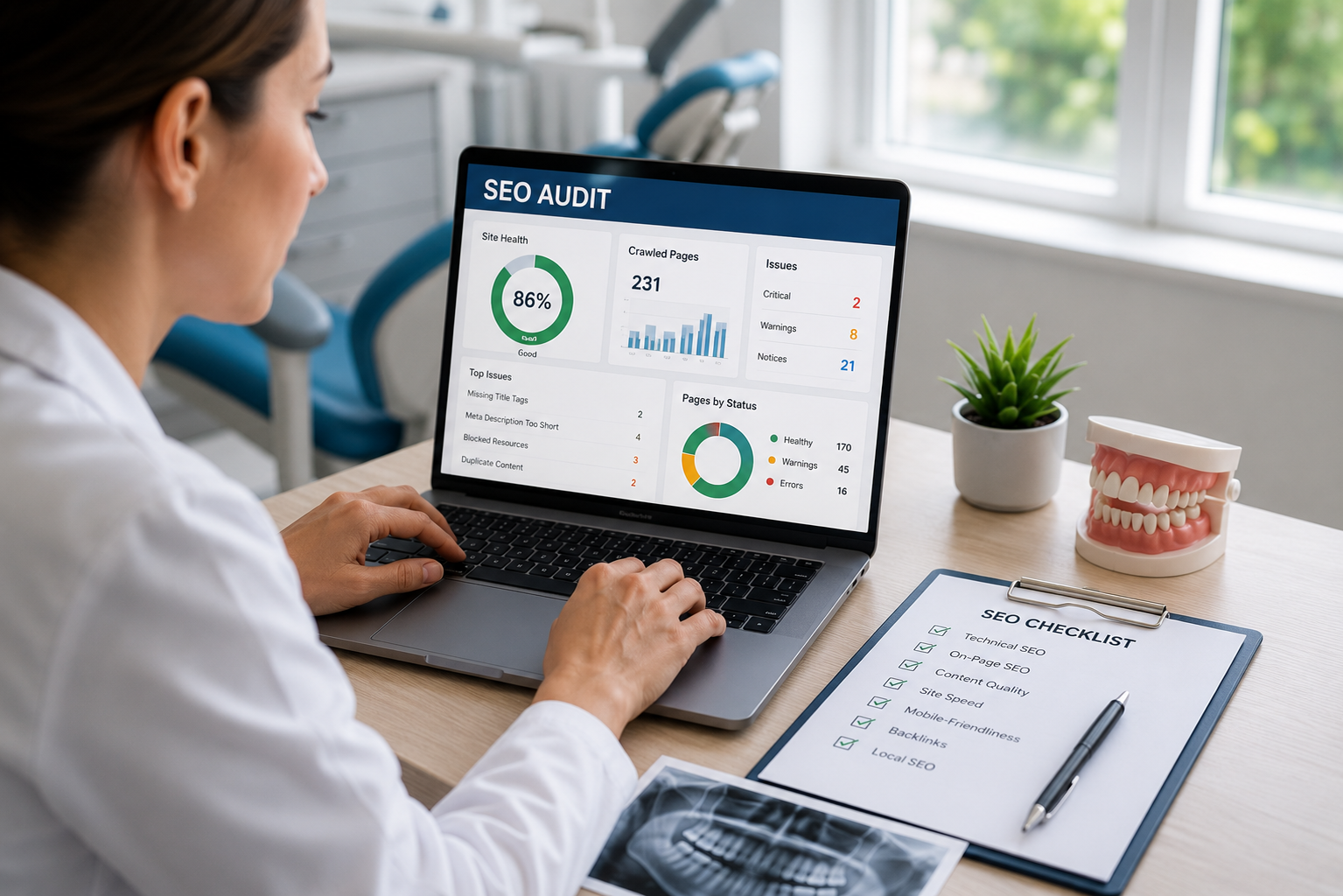
An SEO audit is essential for dental practices that want measurable growth online. A focused audit reveals how your site performs, highlights technical and content gaps, and shows how to better match patient search intent. To strengthen your overall optimisation approach, explore SEO For Dental Clinics as part of your strategy. This guide covers the core audit elements for dental websites: ranking factors, technical checks, and content alignment with patient needs. Addressing these areas helps tackle patient acquisition and retention challenges and improves visibility on Google. For a full strategy and services, review the resources at The Digital Smile.
Reliable online visibility requires a tailored SEO approach. Focus on systematic keyword research, consistent on-page optimization, and local SEO tactics that attract patients searching for dental services in your area.
On-page optimization improves individual pages for search and users. Key actions include unique title tags, clear meta descriptions, and optimised images; each change contributes to better visibility and higher click-through rates.
Effective keyword research guides content and visibility. Use tools such as Google Keyword Planner or SEMrush to identify high-intent search terms, and prioritise local keywords so your practice ranks for nearby patient queries.
A practical SEO checklist tracks the core ranking factors you should review regularly. Below are the fundamental elements every practice owner should monitor to protect and improve search performance.
Review and update this checklist on a set schedule to maintain site health and search visibility.
Improving Google rankings requires a coordinated strategy. Prioritise local SEO to reach community patients and use keyword mapping to direct content creation that attracts relevant traffic.
Stay informed about evolving ranking factors so your approach remains effective and aligned with best practices.
A technical SEO audit inspects your site’s infrastructure for issues that hinder performance. Key checks include site speed, mobile usability, crawlability, and URL structure.
Faster load times improve user experience and reduce bounce rates; mobile-friendly design ensures patients can access information on any device.
Regularly test site speed and mobile performance to identify bottlenecks. Tools like Google PageSpeed Insights offer actionable recommendations to improve load times and responsiveness.
Completing these checks improves user experience and supports higher rankings in search results.
Identifying and fixing crawl errors is essential for indexation. Use Google Search Console to find broken links, server errors, and blocked pages that prevent search engines from accessing content.
Monitor and resolve crawl issues promptly so search engines can index your site accurately and preserve rankings.
Optimise on-page elements to improve discoverability. Create clear, keyword-focused title tags, structured header tags, and meta descriptions that encourage clicks.
Consistent application of these techniques supports better rankings and a clearer user experience.
Meta tags and schema markup improve how search engines present your pages. Focus on concise title tags and structured data that communicates your practice details to search engines.
Proper use of these elements can produce richer search snippets and increase user engagement.
Align content with patient intent by creating pages that answer common questions and reflect the language patients use. Patient-focused content builds relevance and drives organic traffic.
Use targeted keywords in helpful articles and guides to demonstrate expertise and strengthen trust within your local market.
Local SEO is essential for practices that serve nearby patients. Key tactics include optimising your Google Business Profile, soliciting reviews, and using localised keywords throughout site content.
These steps increase local visibility and make it easier for prospective patients to find your practice.
A well-maintained Google My Business listing drives local traffic. Keep your profile complete and accurate, use local keywords in descriptions, and post updates that highlight services or offers.
These practices increase relevance in local search and improve patient engagement.
Consistent local citations and authentic reviews strengthen your online reputation. Maintain an identical name, address, and phone number (NAP) across platforms to avoid confusion and ranking issues.
Proactively asking for and responding to reviews improves credibility and helps convert prospective patients who find your practice online.
AI tools streamline the audit process by analysing large data sets and spotting trends faster than manual methods. They automate routine tasks so practice teams can focus on strategic decisions.
Some essential AI applications for dental SEO include:
Leveraging these tools improves SEO efficiency and helps practices stay aligned with patient behaviour.
AI-powered SEO tools offer clear benefits: better trend analysis to inform services, and automation that reduces workload and errors in marketing tasks.
When applied correctly, these tools can increase patient engagement and improve online visibility.
Integrate AI insights into regular SEO maintenance by monitoring analytics and adapting tactics based on real-time data. This keeps your strategy responsive to changing patient behaviour.
Apply AI-driven recommendations to content and marketing workflows to maintain agility and improve outcomes.
Measuring audit success requires tracking clear KPIs. Focus on organic traffic growth, patient acquisition, and ranking improvements to gauge the audit’s impact.
Maintain focus on these KPIs to ensure your SEO actions deliver measurable results and remain adaptable.
Evaluate patient acquisition using metrics such as organic search traffic, conversion rates for appointment actions, and the volume of leads generated from organic channels.
Tracking these metrics clarifies how the audit contributes to practice growth and where to adjust efforts.
Structured data helps search engines understand your content and can improve how your practice appears in results. Implement schema for services and reviews to support clearer search listings.
Proper use of structured data can improve visibility and encourage bookings. For specific dental SEO services and implementation guidance, consider consulting The Digital Smile .
If you want to learn how referral programmes can support growth, review the details at The Digital Smile Referral Program .
To advance your practice’s online presence, schedule a consultation or Book a Call with their experts to discuss tailored SEO strategies.
Content marketing attracts and informs potential patients while aligning with search intent. High-quality articles, blog posts, and patient guides answer common questions, drive organic traffic, and position the practice as a trusted authority.
Conduct an SEO audit at least twice a year to remain competitive. Perform additional audits after major changes, such as a website redesign or service updates, to ensure strategies stay aligned with search algorithms.
Use relevant schema types (for example, "DentalClinic" or "Physician"), ensure the structured data is accurate and complete, and validate implementation with tools like Google’s Structured Data Testing Tool. Correct schema increases the chance of richer search results.
Local link building boosts local search visibility and community credibility. Backlinks from reputable local businesses, directories, and associations improve domain authority and drive referral traffic from trusted sources.
After an audit, monitor organic traffic, conversion rates for appointments or inquiries, and keyword ranking changes. Track engagement metrics such as bounce rate and average session duration to refine user experience.
Use Google Search Console for crawl and indexing issues, SEMrush or Ahrefs for keyword and competitor analysis, Google PageSpeed Insights for performance testing, and Moz for on-page recommendations to ensure a thorough audit.
Backlinks act as endorsements that increase your site’s authority. Quality links from relevant, reputable sources help improve rankings and drive referral traffic that can convert into new patients.
A thorough SEO audit strengthens a dental practice’s online visibility and patient engagement. By applying best practices and addressing key ranking factors, practices can attract more prospective patients and build local authority. For further guidance, review the resources at TheDigital Smile and take the next step to optimise your practice’s online presence.